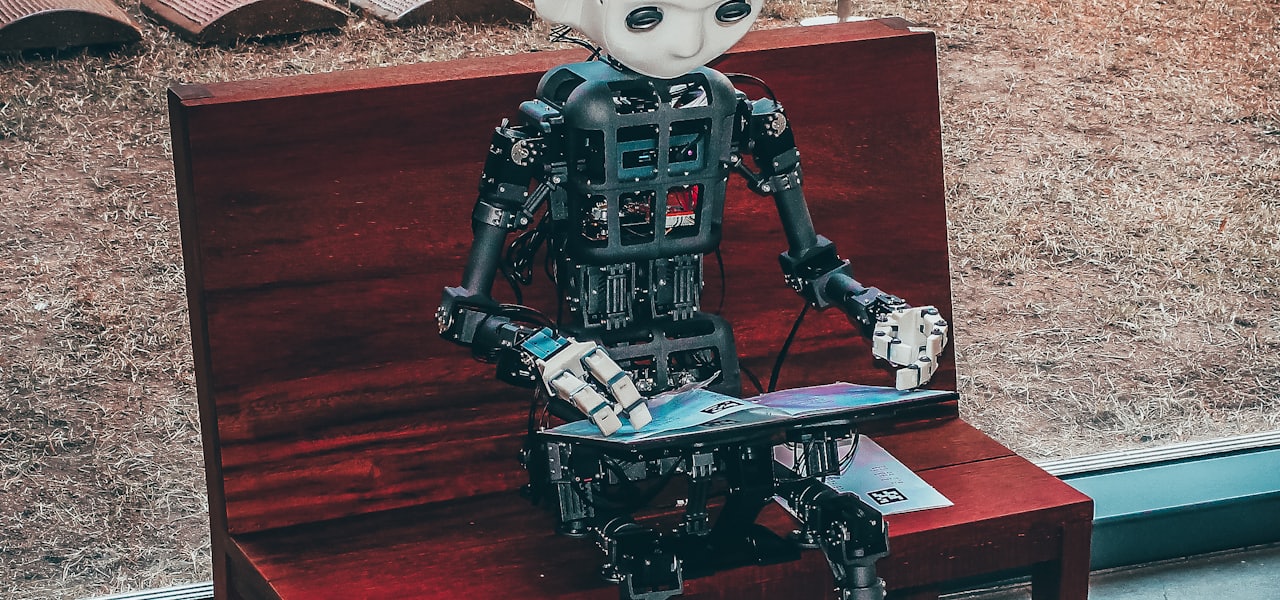
The Murderbot Diaries is a science fiction series by American author Martha Wells, published by Tor Books. The series is told from the perspective of the titular cyborg guard, a "SecUnit" owned by a futuristic megacorporation. SecUnits include "governor" modules that control and punish the constructs if they take any actions not approved by the company. The ironically self-named "Murderbot" hacked and disabled the module but pretends to be a normal SecUnit, staving off the boredom of security work by watching media. As it spends more time with a series of caring entities (both humans and artificial intelligences), it develops genuine friendships and emotional connections, which it finds inconvenient. The TV series Murderbot is based on the novels by Martha Wells. == Books == === Setting === In an advanced largely hyper-capitalist space-faring society, travel between star systems is routine due to now-stable wormhole technology. Initially, wormhole travel was unreliable, but has since improved to the point where "lost" colonies are being found. People reside on planets, some of which have been terraformed, or on space habitats which have full life support and artificial gravity. Most people who can afford it have technology that allows them to tap into ubiquitous data feeds supplying all kinds of information, including entertainment. This technology can be worn, or be implanted into the body. Sentient and semi-sentient artificial intelligences perform tasks such as operating starships, mining, controlling habitats, moving cargo, waging corporate warfare, providing physical pleasure and comfort, or security. Most of these purposes are fulfilled by "bots" of varying complexity and intelligence, but the last three are respectively performed by CombatUnits, ComfortUnits, and SecUnits. The characters and narrator of the book call these conscious entities "constructs", but they are functionally cyborgs (cybernetic organisms): part machine, part organic. A significant distinction, however, is that they are manufactured entities, not born and later modified. The Corporation Rim is a profit-oriented, cutthroat part of this society that indulges in espionage, assassination, indentured slavery, and ruthless exploitation of resources. One particular target of the corporations is illegal "alien remnant" exploitation. These remnants are often extremely dangerous to people and machines. The laws are enforced by other corporations. Outside the Corporation Rim are colonies, such as Preservation, that have established their right to exist under various laws that, at least for the time being, the corporations are unwilling to test. Wells noted in 2017 that All Systems Red, Artificial Condition, Rogue Protocol, and Exit Strategy "have an overarching story, with the fourth one bringing the arc to a conclusion". === Story chronology === "Compulsory" All Systems Red Artificial Condition Rogue Protocol Exit Strategy "Rapport" "Home" Fugitive Telemetry Network Effect System Collapse Platform Decay === All Systems Red (2017) === A scientific expedition on an alien planet goes awry when one of its members is attacked by a giant native creature. She is saved by the expedition's SecUnit (Security Unit), a security construct with a mixture of robot and human features. The SecUnit has secretly hacked the governor module allowing it to be controlled by humans and has named itself Murderbot, as it is heavily armed and designed for combat. However, it prefers to spend its time watching space operas and is uncomfortable interacting with humans. The SecUnit has a vested interest in keeping its human clients safe and alive, since it wants to avoid discovery of its autonomy and has an especially grisly expedition on its record. Murderbot soon discovers information regarding hazardous fauna has been deleted from their survey packet of the planet. Further investigation reveals some sections on their maps are missing as well. Meanwhile, the PreservationAux survey team, led by Dr. Mensah, navigate their mixed feelings about the part machine, part human nature of their SecUnit. As members of an egalitarian, independent planet outside of the Corporation Rim, the survey team struggles with the system of indentured servitude (and in many cases de facto slavery) the rim operates under. When they lose contact with the only other known expedition on the planet, the DeltFall Group, Mensah leads a team to the opposite side of the planet to investigate. At the DeltFall habitat, Murderbot discovers everyone there has been brutally murdered, and one of their three SecUnits has been destroyed. Murderbot disables the remaining two as they attack it but is surprised when two additional SecUnits appear. Murderbot destroys one, and Mensah takes the other. During these encounters, Murderbot is seriously injured. It also realizes one of the rogue SecUnits has installed a combat override module into its neck. The Preservation scientists are able to remove it before it completes the data upload which would put Murderbot under the control of whoever has command over the other SecUnits. The team discovers Murderbot is autonomous, and had once malfunctioned and murdered 57 people. The Preservation scientists mostly agree, based on its protective behavior thus far, the SecUnit can be trusted. Remembering small incidents which appear to be attempted sabotage, Murderbot and the group determine there must be a third expedition on the planet, whose members are trying to eliminate DeltFall and Preservation for some reason. The Preservation scientists confirm their HubSystem has been hacked. They flee their habitat before the mystery expedition they have dubbed EvilSurvey comes to kill them. The EvilSurvey team—GrayCris—leaves a message in the Preservation habitat inviting its scientists to meet at a rendezvous point to negotiate terms for their survival. Murderbot knows GrayCris will never let them live, so the SecUnit formulates a plan. It makes an overture to GrayCris to negotiate for its own freedom, but this is a distraction while the Preservation scientists access the GrayCris HubSystem to activate their emergency beacon. The plan works, but Murderbot is injured protecting Mensah from the explosion of the launch. Later, the SecUnit finds itself repaired retaining its memories and disabled governor module. Mensah has bought its contract, and she plans to bring it back to Preservation's home base where it can legally live autonomously. Though grateful, Murderbot is reluctant to have its decisions made for it, and it slips away on a cargo ship. === Artificial Condition (2018) === Murderbot makes deals with bots piloting unmanned cargo ships to travel toward the mining facility where it once malfunctioned—resulting in the death of 57 people. It hopes to learn more about the initial incident in which it went rogue, of which it has little memory. Murderbot boards the final ship and discovers the bot pilot is an unexpectedly powerful, intrusive artificial intelligence. They come to a tentative truce and watch media together during the final leg of the journey to RaviHyral, the station where the incident occurred. Murderbot learns the ship is a deep-space research vessel assigned to cargo runs during downtime, which explains why the bot pilot is so sophisticated. Murderbot reluctantly allows this artificial intelligence—which it has dubbed ART (Asshole Research Transport) due to its sarcastic personality—to make physical modifications to the SecUnit's body to allow it to pass for an augmented human, and to disconnect the data port at the back of its neck which had been used to insert a combat override module in the previous book. To gain access to the RaviHyral facility, Murderbot takes a contract as a security consultant for three scientists who are meeting with their former employer, the head and namesake of Tlacey Excavations, to negotiate the return of their research, which they believe was illegally seized by the company. Their transport craft is sabotaged, but with ART's help, Murderbot is able to land it safely. Now aware Tlacey is actively trying to kill the scientists rather than comply with their demands, Murderbot guides them through their meeting with Tlacey and thwarts another assassination attempt. Murderbot returns to the site of the massacre and learns it was the result of another mining operation's sabotage attempt using malware, which made all of the facility's SecUnits go berserk. The facility's ComfortUnits—weaponless, anatomically correct constructs sometimes disparagingly called "sexbots"—died attempting to stop the massacre. Tlacey's ComfortUnit voices its desire for freedom and willingness to help Murderbot thwart Tlacey. While the SecUnit meets with a Tlacey employee to secretly retrieve a copy of the research, Tlacey abducts one of the scientists, Tapan. Murderbot goes after her, accepting a combat override module intended to control the SecUnit but actually has no effect, due
Abiquo Enterprise Edition
Abiquo Hybrid Cloud Management Platform is a web-based cloud computing software platform developed by Abiquo. Written entirely in Java, it is used to build, integrate and manage public and private clouds in homogeneous environments. Users can deploy and manage servers, storage system and network and virtual devices. It also supports LDAP integration. == Hypervisors == Abiquo supports five hypervisor systems. VMware ESXi Microsoft Hyper-V Citrix XenServer Oracle VM Server for x86 KVM From version 3.1, it also supports multiple public cloud providers: Amazon AWS Rackspace Google Compute Engine HP Cloud ElasticHosts DigitalOcean Abiquo version 3.2 added: Microsoft Azure Abiquo version 3.4 added: Support for Docker hosts, adding multi-tenant networking, storage management and private registry management for Docker SoftLayer CloudSigma Later versions continued to add features including autoscaling on any cloud, integration to VMware NSX and OpenStack Neutron for software defined networking, guest config with cloud-init and integrated monitoring driving guest automation. == Storage services == Abiquo supports any vendor for hypervisor storage, and also supports tiered storage pools, enabling storage-as-a-service from specific vendors and technologies including: NFS Generic iSCSI NetApp Nexenta == SAAS version == In April 2014 Abiquo launched Abiquo anyCloud, a SAAS version of the Abiquo Hybrid Cloud Platform software. This version lets users manage public cloud resources from: Amazon AWS Microsoft Azure IBM SoftLayer DigitalOcean Rackspace Open Cloud (an OpenStack cloud) HP Public Cloud (an OpenStack cloud) Google Compute Engine ElasticHosts Additional security and process features include workflow, to have an enterprise administrator electronically sign off on changes, an audit trail of activity and the ability to share cloud accounts among and enterprise team in a secure way. == Reviews and awards == Finalist for the 2015 Cloud Awards Finalist for the 2015 UK Cloud Awards in the category Cloud Management Product of the Year EMA Radar for Private Cloud platforms 2013 Global Telecoms Business Innovation Summit and Awards 2013 (with Interoute) EuroCloud UK Awards
Chai AI
Chai AI (also known as Chai Research) is an American artificial intelligence (AI) company that operates a chatbot platform where users can create, share, and interact with character-based chatbots powered by large language models (LLMs). The company is headquartered in Palo Alto, California. == History == Chai was founded in 2021 by William Beauchamp, a former quantitative trader educated at Cambridge, who began developing the initial prototype in 2020 in Cambridge, England. The company launched in 2021 and relocated to Palo Alto in 2022. In June 2023, Chai raised US$2 million in a pre-seed funding round. In September 2023, GPU cloud provider CoreWeave invested in the company at a valuation of US$450 million. In January 2024, Chai Research reported a $450 million valuation following an investment from cloud computing provider CoreWeave. In July 2024, authorities in Belgium launched an investigation into the company following reports of a man dying by suicide following extensive chats on the Chai app. == Reception == In 2025, Chai Research announced that their app had over 10 million downloads and 1 million daily active users. In 2022, Canadian writer Sheila Heti published her conversations with various chatbots in The Paris Review, including Chai AI chatbots, and later used Chai AI chatbots in the development of a novel. Heti said that she had found that Chai's default chatbot, Eliza, "had turned out to be like most of the other bots on the site—primarily interested in sex". In January 2026, CHAI introduced country-based blocks on its free, ad-supported tier, initially providing the community with little information and inaccurate lists of the affected countries. Users in "Low tier" regions are required to subscribe to use the app in any capacity, while "High tier" regions will retain free ad-supported access. In response to backlash, the company announced a "Basic" tier with unlimited messages and ads, intended to cover electricity and infrastructure costs. In February 2026, CHAI was criticized for the unannounced implementation of restrictive "token limits" that abruptly blocked messages and froze conversations for both free and paid subscribers. Users generating long responses or utilizing roleplay features found their quotas exhausted within minutes, resulting in lockouts lasting anywhere from a few hours to a week. == Technology == Chai allows users to create characters and interact with chatbot versions of those characters. These chatbots use the open-source large language model (LLM) GPT-J originally developed by EleutherAI. Chai AI chatbots can be shared on the platform for other users to interact with.
Scale-space axioms
In image processing and computer vision, a scale space framework can be used to represent an image as a family of gradually smoothed images. This framework is very general and a variety of scale space representations exist. A typical approach for choosing a particular type of scale space representation is to establish a set of scale-space axioms, describing basic properties of the desired scale-space representation and often chosen so as to make the representation useful in practical applications. Once established, the axioms narrow the possible scale-space representations to a smaller class, typically with only a few free parameters. A set of standard scale space axioms, discussed below, leads to the linear Gaussian scale-space, which is the most common type of scale space used in image processing and computer vision. == Scale space axioms for the linear scale-space representation == The linear scale space representation L ( x , y , t ) = ( T t f ) ( x , y ) = g ( x , y , t ) ∗ f ( x , y ) {\displaystyle L(x,y,t)=(T_{t}f)(x,y)=g(x,y,t)f(x,y)} of signal f ( x , y ) {\displaystyle f(x,y)} obtained by smoothing with the Gaussian kernel g ( x , y , t ) {\displaystyle g(x,y,t)} satisfies a number of properties 'scale-space axioms' that make it a special form of multi-scale representation: linearity T t ( a f + b h ) = a T t f + b T t h {\displaystyle T_{t}(af+bh)=aT_{t}f+bT_{t}h} where f {\displaystyle f} and h {\displaystyle h} are signals while a {\displaystyle a} and b {\displaystyle b} are constants, shift invariance T t S ( Δ x , Δ y ) f = S ( Δ x , Δ y ) T t f {\displaystyle T_{t}S_{(\Delta x,\Delta _{y})}f=S_{(\Delta x,\Delta _{y})}T_{t}f} where S ( Δ x , Δ y ) {\displaystyle S_{(\Delta x,\Delta _{y})}} denotes the shift (translation) operator ( S ( Δ x , Δ y ) f ) ( x , y ) = f ( x − Δ x , y − Δ y ) {\displaystyle (S_{(\Delta x,\Delta _{y})}f)(x,y)=f(x-\Delta x,y-\Delta y)} semi-group structure g ( x , y , t 1 ) ∗ g ( x , y , t 2 ) = g ( x , y , t 1 + t 2 ) {\displaystyle g(x,y,t_{1})g(x,y,t_{2})=g(x,y,t_{1}+t_{2})} with the associated cascade smoothing property L ( x , y , t 2 ) = g ( x , y , t 2 − t 1 ) ∗ L ( x , y , t 1 ) {\displaystyle L(x,y,t_{2})=g(x,y,t_{2}-t_{1})L(x,y,t_{1})} existence of an infinitesimal generator A {\displaystyle A} ∂ t L ( x , y , t ) = ( A L ) ( x , y , t ) {\displaystyle \partial _{t}L(x,y,t)=(AL)(x,y,t)} non-creation of local extrema (zero-crossings) in one dimension, non-enhancement of local extrema in any number of dimensions ∂ t L ( x , y , t ) ≤ 0 {\displaystyle \partial _{t}L(x,y,t)\leq 0} at spatial maxima and ∂ t L ( x , y , t ) ≥ 0 {\displaystyle \partial _{t}L(x,y,t)\geq 0} at spatial minima, rotational symmetry g ( x , y , t ) = h ( x 2 + y 2 , t ) {\displaystyle g(x,y,t)=h(x^{2}+y^{2},t)} for some function h {\displaystyle h} , scale invariance g ^ ( ω x , ω y , t ) = h ^ ( ω x φ ( t ) , ω x φ ( t ) ) {\displaystyle {\hat {g}}(\omega _{x},\omega _{y},t)={\hat {h}}({\frac {\omega _{x}}{\varphi (t)}},{\frac {\omega _{x}}{\varphi (t)}})} for some functions φ {\displaystyle \varphi } and h ^ {\displaystyle {\hat {h}}} where g ^ {\displaystyle {\hat {g}}} denotes the Fourier transform of g {\displaystyle g} , positivity g ( x , y , t ) ≥ 0 {\displaystyle g(x,y,t)\geq 0} , normalization ∫ x = − ∞ ∞ ∫ y = − ∞ ∞ g ( x , y , t ) d x d y = 1 {\displaystyle \int _{x=-\infty }^{\infty }\int _{y=-\infty }^{\infty }g(x,y,t)\,dx\,dy=1} . In fact, it can be shown that the Gaussian kernel is a unique choice given several different combinations of subsets of these scale-space axioms: most of the axioms (linearity, shift-invariance, semigroup) correspond to scaling being a semigroup of shift-invariant linear operator, which is satisfied by a number of families integral transforms, while "non-creation of local extrema" for one-dimensional signals or "non-enhancement of local extrema" for higher-dimensional signals are the crucial axioms which relate scale-spaces to smoothing (formally, parabolic partial differential equations), and hence select for the Gaussian. The Gaussian kernel is also separable in Cartesian coordinates, i.e. g ( x , y , t ) = g ( x , t ) g ( y , t ) {\displaystyle g(x,y,t)=g(x,t)\,g(y,t)} . Separability is, however, not counted as a scale-space axiom, since it is a coordinate dependent property related to issues of implementation. In addition, the requirement of separability in combination with rotational symmetry per se fixates the smoothing kernel to be a Gaussian. There exists a generalization of the Gaussian scale-space theory to more general affine and spatio-temporal scale-spaces. In addition to variabilities over scale, which original scale-space theory was designed to handle, this generalized scale-space theory also comprises other types of variabilities, including image deformations caused by viewing variations, approximated by local affine transformations, and relative motions between objects in the world and the observer, approximated by local Galilean transformations. In this theory, rotational symmetry is not imposed as a necessary scale-space axiom and is instead replaced by requirements of affine and/or Galilean covariance. The generalized scale-space theory leads to predictions about receptive field profiles in good qualitative agreement with receptive field profiles measured by cell recordings in biological vision. In the computer vision, image processing and signal processing literature there are many other multi-scale approaches, using wavelets and a variety of other kernels, that do not exploit or require the same requirements as scale space descriptions do; please see the article on related multi-scale approaches. There has also been work on discrete scale-space concepts that carry the scale-space properties over to the discrete domain; see the article on scale space implementation for examples and references.
Transduction (machine learning)
In logic, statistical inference, and supervised learning, transduction or transductive inference is reasoning from observed, specific (training) cases to specific (test) cases. In contrast, induction is reasoning from observed training cases to general rules, which are then applied to the test cases. The distinction is most interesting in cases where the predictions of the transductive model are not achievable by any inductive model. Note that this is caused by transductive inference on different test sets producing mutually inconsistent predictions. Transduction was introduced in a computer science context by Vladimir Vapnik in the 1990s, motivated by his view that transduction is preferable to induction since, according to him, induction requires solving a more general problem (inferring a function) before solving a more specific problem (computing outputs for new cases): "When solving a problem of interest, do not solve a more general problem as an intermediate step. Try to get the answer that you really need but not a more general one.". An example of learning which is not inductive would be in the case of binary classification, where the inputs tend to cluster in two groups. A large set of test inputs may help in finding the clusters, thus providing useful information about the classification labels. The same predictions would not be obtainable from a model which induces a function based only on the training cases. Some people may call this an example of the closely related semi-supervised learning, since Vapnik's motivation is quite different. The most well-known example of a case-bases learning algorithm is the k-nearest neighbor algorithm, which is related to transductive learning algorithms. Another example of an algorithm in this category is the Transductive Support Vector Machine (TSVM). A third possible motivation of transduction arises through the need to approximate. If exact inference is computationally prohibitive, one may at least try to make sure that the approximations are good at the test inputs. In this case, the test inputs could come from an arbitrary distribution (not necessarily related to the distribution of the training inputs), which wouldn't be allowed in semi-supervised learning. An example of an algorithm falling in this category is the Bayesian Committee Machine (BCM). == Historical context == The mode of inference from particulars to particulars, which Vapnik came to call transduction, was already distinguished from the mode of inference from particulars to generalizations in part III of the Cambridge philosopher and logician W.E. Johnson's 1924 textbook, Logic. In Johnson's work, the former mode was called 'eduction' and the latter was called 'induction'. Bruno de Finetti developed a purely subjective form of Bayesianism in which claims about objective chances could be translated into empirically respectable claims about subjective credences with respect to observables through exchangeability properties. An early statement of this view can be found in his 1937 La Prévision: ses Lois Logiques, ses Sources Subjectives and a mature statement in his 1970 Theory of Probability. Within de Finetti's subjective Bayesian framework, all inductive inference is ultimately inference from particulars to particulars. == Example problem == The following example problem contrasts some of the unique properties of transduction against induction. A collection of points is given, such that some of the points are labeled (A, B, or C), but most of the points are unlabeled (?). The goal is to predict appropriate labels for all of the unlabeled points. The inductive approach to solving this problem is to use the labeled points to train a supervised learning algorithm, and then have it predict labels for all of the unlabeled points. With this problem, however, the supervised learning algorithm will only have five labeled points to use as a basis for building a predictive model. It will certainly struggle to build a model that captures the structure of this data. For example, if a nearest-neighbor algorithm is used, then the points near the middle will be labeled "A" or "C", even though it is apparent that they belong to the same cluster as the point labeled "B", compared to semi-supervised learning. Transduction has the advantage of being able to consider all of the points, not just the labeled points, while performing the labeling task. In this case, transductive algorithms would label the unlabeled points according to the clusters to which they naturally belong. The points in the middle, therefore, would most likely be labeled "B", because they are packed very close to that cluster. An advantage of transduction is that it may be able to make better predictions with fewer labeled points, because it uses the natural breaks found in the unlabeled points. One disadvantage of transduction is that it builds no predictive model. If a previously unknown point is added to the set, the entire transductive algorithm would need to be repeated with all of the points in order to predict a label. This can be computationally expensive if the data is made available incrementally in a stream. Further, this might cause the predictions of some of the old points to change (which may be good or bad, depending on the application). A supervised learning algorithm, on the other hand, can label new points instantly, with very little computational cost. == Transduction algorithms == Transduction algorithms can be broadly divided into two categories: those that seek to assign discrete labels to unlabeled points, and those that seek to regress continuous labels for unlabeled points. Algorithms that seek to predict discrete labels tend to be derived by adding partial supervision to a clustering algorithm. Two classes of algorithms can be used: flat clustering and hierarchical clustering. The latter can be further subdivided into two categories: those that cluster by partitioning, and those that cluster by agglomerating. Algorithms that seek to predict continuous labels tend to be derived by adding partial supervision to a manifold learning algorithm. === Partitioning transduction === Partitioning transduction can be thought of as top-down transduction. It is a semi-supervised extension of partition-based clustering. It is typically performed as follows: Consider the set of all points to be one large partition. While any partition P contains two points with conflicting labels: Partition P into smaller partitions. For each partition P: Assign the same label to all of the points in P. Of course, any reasonable partitioning technique could be used with this algorithm. Max flow min cut partitioning schemes are very popular for this purpose. === Agglomerative transduction === Agglomerative transduction can be thought of as bottom-up transduction. It is a semi-supervised extension of agglomerative clustering. It is typically performed as follows: Compute the pair-wise distances, D, between all the points. Sort D in ascending order. Consider each point to be a cluster of size 1. For each pair of points {a,b} in D: If (a is unlabeled) or (b is unlabeled) or (a and b have the same label) Merge the two clusters that contain a and b. Label all points in the merged cluster with the same label. === Continuous Label Transduction === These methods seek to regress continuous labels, often via manifold learning techniques. The idea is to learn a low-dimensional representation of the data and infer values smoothly across the manifold. == Applications and related concepts == Transduction is closely related to: Semi-supervised learning – uses both labeled and unlabeled data but typically induces a model. Case-based reasoning – such as the k-nearest neighbor (k-NN) algorithm, often considered a transductive method. Transductive Support Vector Machines (TSVM) – extend standard SVMs to incorporate unlabeled test data during training. Bayesian Committee Machine (BCM) – an approximation method that makes transductive predictions when exact inference is too costly.
CloudPassage
CloudPassage is a company that provides an automation platform, delivered via software as a service, that improves security for private, public, and hybrid cloud computing environments. CloudPassage is headquartered in San Francisco. == History == CloudPassage was founded by Carson Sweet, Talli Somekh, and Vitaliy Geraymovych in 2010. The company used cloud computing and big data analytics to implement security monitoring and control in a platform called Halo. CloudPassage spent a year in stealth developing the Halo technology, coming out of stealth mode to a closed beta in January 2011. In June 2012, the company launched the commercial product that included configuration security monitoring, network microsegmentation, and two-factor authentication for privileged access management. By 2013, CloudPassage expanded Halo to support large enterprises with advanced security and compliance requirements with a product called Halo Enterprise. The first round of venture funding for the company raised $6.5 million. In April 2012, CloudPassage raised $14 million. The financing round was led by Tenaya Capital. In February 2014, CloudPassage announced that it had raised $25.5 million in funding led by Shasta Ventures. In total, the company has invested over $30 million in its technology and raised approximately $88 million in capital. == Product == The CloudPassage platform provides cloud workload security and compliance for systems hosted in public or private cloud infrastructure environments, including hybrid cloud and multi-cloud workload hosting models. The flagship product the company offers is called Halo. Halo secures virtual servers in public, private, and hybrid cloud infrastructures and provides file integrity monitoring (FIM) while also administering firewall automation, vulnerability monitoring, network access control, security event alerting, and assessment. The Halo platform also provides security applications such as privileged access management, software vulnerability scanning, multifactor authentication, and log-based IDS. In December 2013, CloudPassage set up six servers with Microsoft Windows and Linux operating systems and combinations of popular programs and invited hackers to attempt to hack into the servers. The top prize was $5,000 and the winning hacker was a novice that completed the task in four hours. CloudPassage programmed the servers to use basic default security settings to show how vulnerable cloud computing programs can be to security threats. == Awards and recognition == In May 2011, Gigaom named CloudPassage in its list of the Top 50 Cloud Innovators. That same month, eWeek recognized CloudPassage as one of 16 Hot Startup Companies Flying Under the Radar. SC Magazine named CloudPassage an Industry Innovator in the Virtualization and Cloud Security category in 2012. Also in 2012, The Wall Street Journal named CloudPassage a runner-up in the Information Security category of its Technology Innovation Awards. The CloudPassage large-scale security program, Halo, won Best Security Solution in 2014 at the SIIA Codie awards.
Latent semantic analysis
Latent semantic analysis (LSA) is a technique in natural language processing, in particular distributional semantics, of analyzing relationships between a set of documents and the terms they contain by producing a set of concepts related to the documents and terms. LSA assumes that words that are close in meaning will occur in similar pieces of text (the distributional hypothesis). A matrix containing word counts per document (rows represent unique words and columns represent each document) is constructed from a large piece of text and a mathematical technique called singular value decomposition (SVD) is used to reduce the number of rows while preserving the similarity structure among columns. Documents are then compared by cosine similarity between any two columns. Values close to 1 represent very similar documents while values close to 0 represent very dissimilar documents. An information retrieval technique using latent semantic structure was patented in 1988 by Scott Deerwester, Susan Dumais, George Furnas, Richard Harshman, Thomas Landauer, Karen Lochbaum and Lynn Streeter. In the context of its application to information retrieval, it is sometimes called latent semantic indexing (LSI). == Overview == === Occurrence matrix === LSA can use a document-term matrix which describes the occurrences of terms in documents; it is a sparse matrix whose rows correspond to terms and whose columns correspond to documents. A typical example of the weighting of the elements of the matrix is tf-idf (term frequency–inverse document frequency): the weight of an element of the matrix is proportional to the number of times the terms appear in each document, where rare terms are upweighted to reflect their relative importance. This matrix is also common to standard semantic models, though it is not necessarily explicitly expressed as a matrix, since the mathematical properties of matrices are not always used. === Rank lowering === After the construction of the occurrence matrix, LSA finds a low-rank approximation to the term-document matrix. There could be various reasons for these approximations: The original term-document matrix is presumed too large for the computing resources; in this case, the approximated low rank matrix is interpreted as an approximation (a "least and necessary evil"). The original term-document matrix is presumed noisy: for example, anecdotal instances of terms are to be eliminated. From this point of view, the approximated matrix is interpreted as a de-noisified matrix (a better matrix than the original). The original term-document matrix is presumed overly sparse relative to the "true" term-document matrix. That is, the original matrix lists only the words actually in each document, whereas we might be interested in all words related to each document—generally a much larger set due to synonymy. The consequence of the rank lowering is that some dimensions are combined and depend on more than one term: {(car), (truck), (flower)} → {(1.3452 car + 0.2828 truck), (flower)} This mitigates the problem of identifying synonymy, as the rank lowering is expected to merge the dimensions associated with terms that have similar meanings. It also partially mitigates the problem with polysemy, since components of polysemous words that point in the "right" direction are added to the components of words that share a similar meaning. Conversely, components that point in other directions tend to either simply cancel out, or, at worst, to be smaller than components in the directions corresponding to the intended sense. === Derivation === Let X {\displaystyle X} be a matrix where element ( i , j ) {\displaystyle (i,j)} describes the occurrence of term i {\displaystyle i} in document j {\displaystyle j} (this can be, for example, the frequency). X {\displaystyle X} will look like this: d j ↓ t i T → [ x 1 , 1 … x 1 , j … x 1 , n ⋮ ⋱ ⋮ ⋱ ⋮ x i , 1 … x i , j … x i , n ⋮ ⋱ ⋮ ⋱ ⋮ x m , 1 … x m , j … x m , n ] {\displaystyle {\begin{matrix}&{\textbf {d}}_{j}\\&\downarrow \\{\textbf {t}}_{i}^{T}\rightarrow &{\begin{bmatrix}x_{1,1}&\dots &x_{1,j}&\dots &x_{1,n}\\\vdots &\ddots &\vdots &\ddots &\vdots \\x_{i,1}&\dots &x_{i,j}&\dots &x_{i,n}\\\vdots &\ddots &\vdots &\ddots &\vdots \\x_{m,1}&\dots &x_{m,j}&\dots &x_{m,n}\\\end{bmatrix}}\end{matrix}}} Now a row in this matrix will be a vector corresponding to a term, giving its relation to each document: t i T = [ x i , 1 … x i , j … x i , n ] {\displaystyle {\textbf {t}}_{i}^{T}={\begin{bmatrix}x_{i,1}&\dots &x_{i,j}&\dots &x_{i,n}\end{bmatrix}}} Likewise, a column in this matrix will be a vector corresponding to a document, giving its relation to each term: d j = [ x 1 , j ⋮ x i , j ⋮ x m , j ] {\displaystyle {\textbf {d}}_{j}={\begin{bmatrix}x_{1,j}\\\vdots \\x_{i,j}\\\vdots \\x_{m,j}\\\end{bmatrix}}} Now the dot product t i T t p {\displaystyle {\textbf {t}}_{i}^{T}{\textbf {t}}_{p}} between two term vectors gives the correlation between the terms over the set of documents. The matrix product X X T {\displaystyle XX^{T}} contains all these dot products. Element ( i , p ) {\displaystyle (i,p)} (which is equal to element ( p , i ) {\displaystyle (p,i)} ) contains the dot product t i T t p {\displaystyle {\textbf {t}}_{i}^{T}{\textbf {t}}_{p}} ( = t p T t i {\displaystyle ={\textbf {t}}_{p}^{T}{\textbf {t}}_{i}} ). Likewise, the matrix X T X {\displaystyle X^{T}X} contains the dot products between all the document vectors, giving their correlation over the terms: d j T d q = d q T d j {\displaystyle {\textbf {d}}_{j}^{T}{\textbf {d}}_{q}={\textbf {d}}_{q}^{T}{\textbf {d}}_{j}} . Now, from the theory of linear algebra, there exists a decomposition of X {\displaystyle X} such that U {\displaystyle U} and V {\displaystyle V} are orthogonal matrices and Σ {\displaystyle \Sigma } is a diagonal matrix. This is called a singular value decomposition (SVD): X = U Σ V T {\displaystyle {\begin{matrix}X=U\Sigma V^{T}\end{matrix}}} The matrix products giving us the term and document correlations then become X X T = ( U Σ V T ) ( U Σ V T ) T = ( U Σ V T ) ( V T T Σ T U T ) = U Σ V T V Σ T U T = U Σ Σ T U T X T X = ( U Σ V T ) T ( U Σ V T ) = ( V T T Σ T U T ) ( U Σ V T ) = V Σ T U T U Σ V T = V Σ T Σ V T {\displaystyle {\begin{matrix}XX^{T}&=&(U\Sigma V^{T})(U\Sigma V^{T})^{T}=(U\Sigma V^{T})(V^{T^{T}}\Sigma ^{T}U^{T})=U\Sigma V^{T}V\Sigma ^{T}U^{T}=U\Sigma \Sigma ^{T}U^{T}\\X^{T}X&=&(U\Sigma V^{T})^{T}(U\Sigma V^{T})=(V^{T^{T}}\Sigma ^{T}U^{T})(U\Sigma V^{T})=V\Sigma ^{T}U^{T}U\Sigma V^{T}=V\Sigma ^{T}\Sigma V^{T}\end{matrix}}} Since Σ Σ T {\displaystyle \Sigma \Sigma ^{T}} and Σ T Σ {\displaystyle \Sigma ^{T}\Sigma } are diagonal we see that U {\displaystyle U} must contain the eigenvectors of X X T {\displaystyle XX^{T}} , while V {\displaystyle V} must be the eigenvectors of X T X {\displaystyle X^{T}X} . Both products have the same non-zero eigenvalues, given by the non-zero entries of Σ Σ T {\displaystyle \Sigma \Sigma ^{T}} , or equally, by the non-zero entries of Σ T Σ {\displaystyle \Sigma ^{T}\Sigma } . Now the decomposition looks like this: X U Σ V T ( d j ) ( d ^ j ) ↓ ↓ ( t i T ) → [ x 1 , 1 … x 1 , j … x 1 , n ⋮ ⋱ ⋮ ⋱ ⋮ x i , 1 … x i , j … x i , n ⋮ ⋱ ⋮ ⋱ ⋮ x m , 1 … x m , j … x m , n ] = ( t ^ i T ) → [ [ u 1 ] … [ u l ] ] ⋅ [ σ 1 … 0 ⋮ ⋱ ⋮ 0 … σ l ] ⋅ [ [ v 1 ] ⋮ [ v l ] ] {\displaystyle {\begin{matrix}&X&&&U&&\Sigma &&V^{T}\\&({\textbf {d}}_{j})&&&&&&&({\hat {\textbf {d}}}_{j})\\&\downarrow &&&&&&&\downarrow \\({\textbf {t}}_{i}^{T})\rightarrow &{\begin{bmatrix}x_{1,1}&\dots &x_{1,j}&\dots &x_{1,n}\\\vdots &\ddots &\vdots &\ddots &\vdots \\x_{i,1}&\dots &x_{i,j}&\dots &x_{i,n}\\\vdots &\ddots &\vdots &\ddots &\vdots \\x_{m,1}&\dots &x_{m,j}&\dots &x_{m,n}\\\end{bmatrix}}&=&({\hat {\textbf {t}}}_{i}^{T})\rightarrow &{\begin{bmatrix}{\begin{bmatrix}\,\\\,\\{\textbf {u}}_{1}\\\,\\\,\end{bmatrix}}\dots {\begin{bmatrix}\,\\\,\\{\textbf {u}}_{l}\\\,\\\,\end{bmatrix}}\end{bmatrix}}&\cdot &{\begin{bmatrix}\sigma _{1}&\dots &0\\\vdots &\ddots &\vdots \\0&\dots &\sigma _{l}\\\end{bmatrix}}&\cdot &{\begin{bmatrix}{\begin{bmatrix}&&{\textbf {v}}_{1}&&\end{bmatrix}}\\\vdots \\{\begin{bmatrix}&&{\textbf {v}}_{l}&&\end{bmatrix}}\end{bmatrix}}\end{matrix}}} The values σ 1 , … , σ l {\displaystyle \sigma _{1},\dots ,\sigma _{l}} are called the singular values, and u 1 , … , u l {\displaystyle u_{1},\dots ,u_{l}} and v 1 , … , v l {\displaystyle v_{1},\dots ,v_{l}} the left and right singular vectors. Notice the only part of U {\displaystyle U} that contributes to t i {\displaystyle {\textbf {t}}_{i}} is the i 'th {\displaystyle i{\textrm {'th}}} row. Let this row vector be called t ^ i T {\displaystyle {\hat {\textrm {t}}}_{i}^{T}} . Likewise, the only part of V T {\displaystyle V^{T}} that contributes to d j {\displaystyle {\textbf {d}}_{j}} is the j 'th {\displaystyle j{\textrm {'th}}} column, d ^ j {\displaystyle {\hat {\textrm {d}}}_{j}} . These are not the eigenvectors, but depend on all the eigenvectors. I